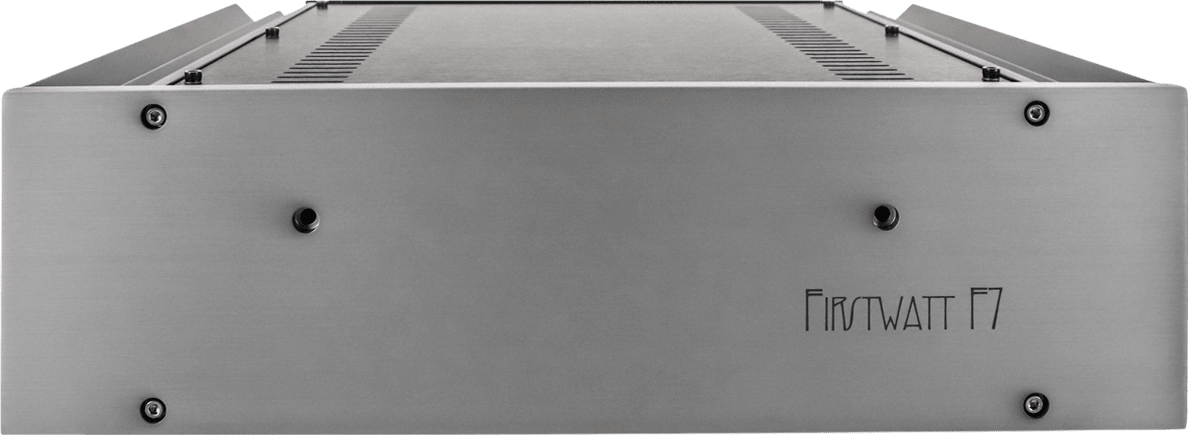
F7
New here? ExtremeHiFi is a free hifi encyclopedia: reviews, prices and used listings. We don’t sell anything.
Summary
What reviewers love
The First Watt F7 is a unique amplifier offering a musical and emotionally connecting experience, especially when paired with sensitive speakers and a good pre-amplifier. Its simple design and focus on the 'first watt' result in a sound that makes one want to keep listening.
Product Strengths
- Simplistic circuit design for sonic purity
- Balances negative and positive current feedback for improved control over reactive speaker loads
- Textural sweetness and warm tonality, with a rare upper-register sheen and transient finesse for a solid-state amplifier
- Excellent soundstaging with holographic presentation on the right recordings
- Delivers a holistic and effortless stream of musical information
Product Considerations
- Its 20 watts per channel requires efficient speakers to achieve satisfactory volume levels
- Some reviewers suggest that a high-gain active preamplifier might be a better pairing than a passive linestage
- It requires a quality pre-amplifier to sound magnificent, it does not pair well with the Hegel pre-out
- Won't make poor recordings sound good, it is only slightly warmer than neutral and will reveal flaws in the recording
Comparisons (according to reviewers)
- Compared to the Emotiva UPA200, it strips away a glare and hashiness, and has a much more natural sound
- Compared to the single-ended F3, it was better controlled in the bass range and displayed more personality—being more seductive and musical
- Compared to the Pass Labs XA 30.8, it has sonic virtues that in many ways rival the XA 30.8, but sounds a bit more raw and unpolished
- Compared to the Willsenton R8, the mid-range of the First Watt F7 is better
Takeaway: The First Watt F7 is a unique amplifier offering a musical and emotionally connecting experience, especially when paired with sensitive speakers and a good pre-amplifier. Its simple design and focus on the 'first watt' result in a sound that makes one want to keep listening.
Written reviews0
Awards0

Integrated, power, and headphone amplifiers compared by power, design class (A, AB, D, or tube), and the features that matter for a given pair of speakers.
Buying tips that apply to the F7
- Size power to the speakers and room. Each 3 dB of speaker sensitivity halves the power needed, so check sensitivity before watts. A desk setup needs 20–30 W; less sensitive speakers in a large room may need 100 W or more.
- Below about $2,000, integrated amps usually give better value than separates, because the money goes into one chassis and power supply instead of two.
- Used amps from established brands such as Bryston, Pass Labs, and Parasound hold up well and are often good value.
- Check power into 4 ohms as well as 8. An amp that nearly doubles its output into 4 ohms has a strong power supply and will handle difficult speakers.
- Look for continuous power across the full 20 Hz–20 kHz band. Peak figures or power at a single frequency make an amp look stronger than it is.
- A signal-to-noise ratio above 100 dB keeps background hiss inaudible, which matters most with sensitive speakers.
- Low-impedance speakers such as Magnepans need an amp that's stable into 4 ohms or lower, so check the spec before buying.
- Good amps differ more in how they handle dynamics and high volume than in frequency response, so audition them at normal listening levels.
Features and specs
Manufacturer's description

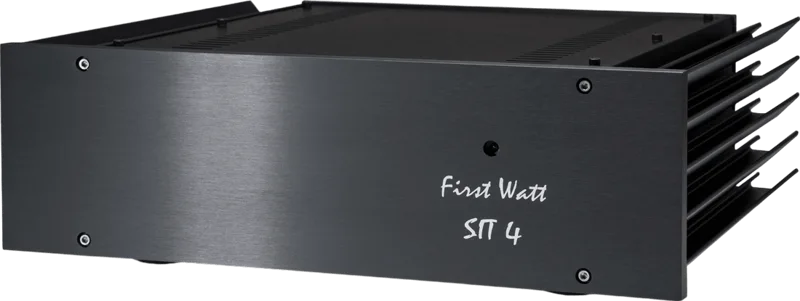


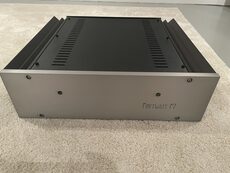
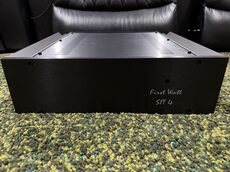
All used First Watt
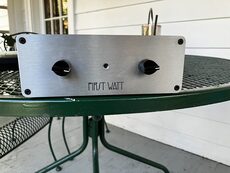
Where to buy the F712 dealers
About First Watt
First Watt is the low-power amplifier company Nelson Pass started as a kitchen-table project, separate from his more commercial company, Pass Labs. Since 1998 it has released a series of simple Class A designs, each with its own circuit, using little or no feedback and rated at 25 watts or less. Several use uncommon parts, including the Static Induction Transistors in the SIT-1 through SIT-4 and the NOS Toshiba JFETs in the F8. The amplifiers are a natural match for efficient loudspeakers, and the J2 is on our All Class A Amplifiers list.
Brand highlights
- First Watt amplifiers prioritize simplicity and elegance in design, often featuring only a few gain stages and a minimum number of parts.
- The brand has a reputation for using uncommon or out-of-production components, such as Static Induction Transistors (SITs) and specific JFETs, to achieve a unique sonic signature.
- They often operate in Class A with low power output, typically 25 watts or less, emphasizing sound quality and harmonic accuracy over raw power.
- First Watt does not conform to a specific formula and various topologies are explored, with and without feedback, and with various active devices, each amplifier is unique.