

Welcome
Inside a tube amplifier, electrons flow through glass vacuum tubes instead of transistors, bouncing off grids and metal plates along the way. While this tech predates modern solid-state amps by decades, music lovers prize tube amps for creating "even-order harmonics" when pushed to their limits.
These harmonics add a rich, warm quality that makes vocals and acoustic instruments shine. The tubes slowly wear out like light bulbs, gradually changing how your music sounds.
These tubes run blazing hot at over 300°F, demanding careful engineering to keep the amp stable. For listeners who don't mind some extra maintenance, a well-built tube amp delivers a unique sound that solid-state just can't match.
What to look for when choosing an amp


So you want to buy a new amplifier, but you are not sure what you should pay attention to. At ExtremeHiFi, we have the world's largest database for audio products. Here is a brief overview of the most important functions and design aspects that distinguish amplifiers and that you should pay attention to.
The first and most important aspect of an amplifier is how much power it has. Can it actually drive your speakers? The easiest way to check this is to look at what the manufacturer recommends for your speakers. At ExtremeHiFi, you can see the recommended performance in the specifications section and ask your manufacturer if they don't provide this information.
Certain types of speakers, such as horns, are often much more sensitive and in many cases require only a little wattage to become extraordinarily loud. Therefore, you shouldn't buy a 100W per channel amplifier for sensitive horns, as you won't use most of the dynamic range of the amplifier. You'll achieve better results with a lower-powered amplifier. However, if you have something like Focal Grande Utopias that require a few hundred watts, you should make sure that you buy an amplifier with sufficient power to drive the speakers properly, without being too quiet or distorted from overexertion.
In the upper market segment, many people prefer monoblock amplifiers. These amplifiers only have one channel, so you have to buy two of them. This can have some advantages in terms of quality. They take up more space and probably cost more than a corresponding stereo amplifier. However, since the amplifiers are spatially distant from each other, there is no possibility of electrical interference or so-called crosstalk between the two channels. In addition, they have their own power supply. So if one channel is heavily tasked, the other is not affected in any way. They have their own heat dissipation, and with monoblock amplifiers, you can generally achieve a slightly higher performance limit than with a stereo amplifier.
When deciding which amplifier to buy, there is a third criterion that can have a drastic influence on the sound that you actually get and on some compromises that you have to make. This is the class of the amplifier, where the three most common options are Class A, Class AB, and Class D.
Class A amplifiers have the reputation among audio experts to offer the best sound quality. This is mainly because Class A amplifiers are the purest form of audio amplification. They have a single or a group of transistors that amplify the entire cycle of the audio signal—completely positive and negative. This means that the behavior at different levels is extremely consistent, and many people think that Class A amplifiers sound best.
But that's a trend, not a rule. There are many terrible Class A amplifiers, but also many fantastic Class AB and Class D amplifiers.
In fact, most people do not use Class A amplifiers because the compromises that you have to make are quite large. They generate a huge amount of heat. If you need a stereo amplifier with 100W per channel, a Class A amplifier could permanently draw 800W from the socket, even at idle, and release this power as heat into your room. Especially if you have high power demands for your speakers, a Class A amplifier may simply not be practical.
Class AB amplifiers work similarly to Class A amplifiers. Instead of a single group of transistors that amplify the entire positive and negative cycle, they have one group that amplifies the positive cycle, another group that amplifies the negative cycle, and the summed output signal is the intended audio signal. This has the advantage that they are much more efficient. At idle, they don't consume as much energy as a Class A amplifier. They run much cooler, and you can often get much more power from a physically smaller device because you don't have to dissipate so much heat.
However, this also means that the distortion behavior of Class AB amplifiers in relation to the output level can be slightly different from that of Class A amplifiers. Nowadays, however, the quality difference between Class A and Class AB amplifiers has diminished significantly compared to earlier times, possibly even no longer existing. There are some fantastic Class AB amplifiers on the market.
So if you have very sensitive speakers, it can still be worthwhile to look at Class A amplifiers, as it is much easier to get a Class A amplifier with 20W per channel than one with 100 or 200W.
However, if you have power-hungry speakers, don't think that you have to sacrifice a lot when buying a Class AB amplifier, as some of the Class AB products on the market are really extraordinary.
Now, there is a third category of amplifiers that is becoming more and more popular, the so-called Class D. These amplifiers work completely differently than Class A and Class AB. Instead of amplifying the signal one-to-one, they actually turn it into a series of extremely high-frequency pulses. If you then use a low-pass filter that filters out the high-frequency components, the originally intended signal is reproduced.
Class D is particularly suitable for requirements with very high power and a small form factor. It is often found in subwoofers, in car radios, or in places where you need a lot of power in a small housing. This is because Class D is the most efficient amplifier type, often over 90 percent efficient. This means that they consume almost no more electricity than they actually output. They emit almost no heat.
Another important aspect to consider in addition to the amplifier class is whether you want a transistor or a tube amplifier. Tube amplifiers are usually Class A amplifiers but use tubes instead of transistors and are objectively less accurate than most transistor amplifiers. They have higher distortion and color the sound more than a typical transistor amplifier. But the reason why so many of them are still produced and why they are still so popular is that some of these distortions and colorations provide a really pleasant end result that many people prefer over a more neutral, linear, or accurate sound. So if you prefer a warmer, slightly colored, but more pleasant sound, a tube amplifier could be something for you.
Regardless of how powerful your required amplifier should be or which amplifier class you prefer, you should consider whether you need a power amplifier or an integrated amplifier. Power amplifiers are extremely common in audio technology and do not have their own volume control. They are called power amplifiers because they provide a fixed gain. They take an input signal that is amplified by a fixed amount, and that's all. For this reason, when buying power amplifiers, you should make sure that either your DAC has an integrated volume control that you can use, or that you use a separate preamplifier for the volume control.
Power amplifiers don't omit volume controls for cost reasons, but because for quality reasons you don't want to have the sensitive line-level circuit as close to a large, powerful amplifier as possible. For higher-quality setups, instead of an amplifier with an integrated volume control (which is referred to as an integrated amplifier), you usually use a separate power amplifier and then a preamplifier or a DAC with an integrated volume control, rather than having all the sensitive circuitry in the same device as the amplifier itself.
However, if you have limited space, you can look for an integrated amplifier, which combines the functions of the power amplifier and the preamplifier and often includes both the input circuit and the volume control. Sometimes the DAC itself is also housed in the same device.
There are so many different amplifiers on the market, which are all suitable for different tastes and preferences. The best way to find out what is actually suitable for your personal preferences is to read the reviews and see what people say about them. With ExtremeHiFi, this is very easy thanks to our rating system. You can go to each product page and take a quick look. This gives you an overview of what people think about it and which competing products you should pay attention to.
Products on this list





.svg)
What reviewers think
Product Strengths
- Exceptional midrange detail and gracefulness
- Extended and complete bass and treble performance
- Capable of driving a wide array of speakers, especially those with high sensitivity (90dB or above)
- Recreates the original spectral balance and harmonic structure of recorded material with great detail
- Produces a three-dimensional soundstage without boundaries due to its transparency
Product Considerations
- No-feedback design means adding feedback can soften the sound and foreshorten the soundstage
- Maintenance includes periodic tube replacement
- It is best to pair with speakers that work well with the amp's characteristics rather than trying to tailor the amp using feedback
- Uses hard-to-find tubes that have no substitutes
- Aesthetics are very basic and lab-like, which some may find unappealing
Comparisons (according to reviewers)
- Vs Lamm ML2.1: Offers more midrange detail, more bass depth and liquidity, and more transient speed and definition
- Vs Atma-Sphere MA-2 Mk III: The Atma-Sphere has greater transparency, while low frequencies are better integrated
Takeaway: The Lamm ML3 Signature is an amplifier that is capable of recreating music in a very realistic way, with a level of detail that makes music sound incredibly lifelike. If true-to-life sound is valued, this amplifier could really bring music to life.
Video review
About the brand


What reviewers think
Video review
About the brand

What reviewers think
Product Strengths
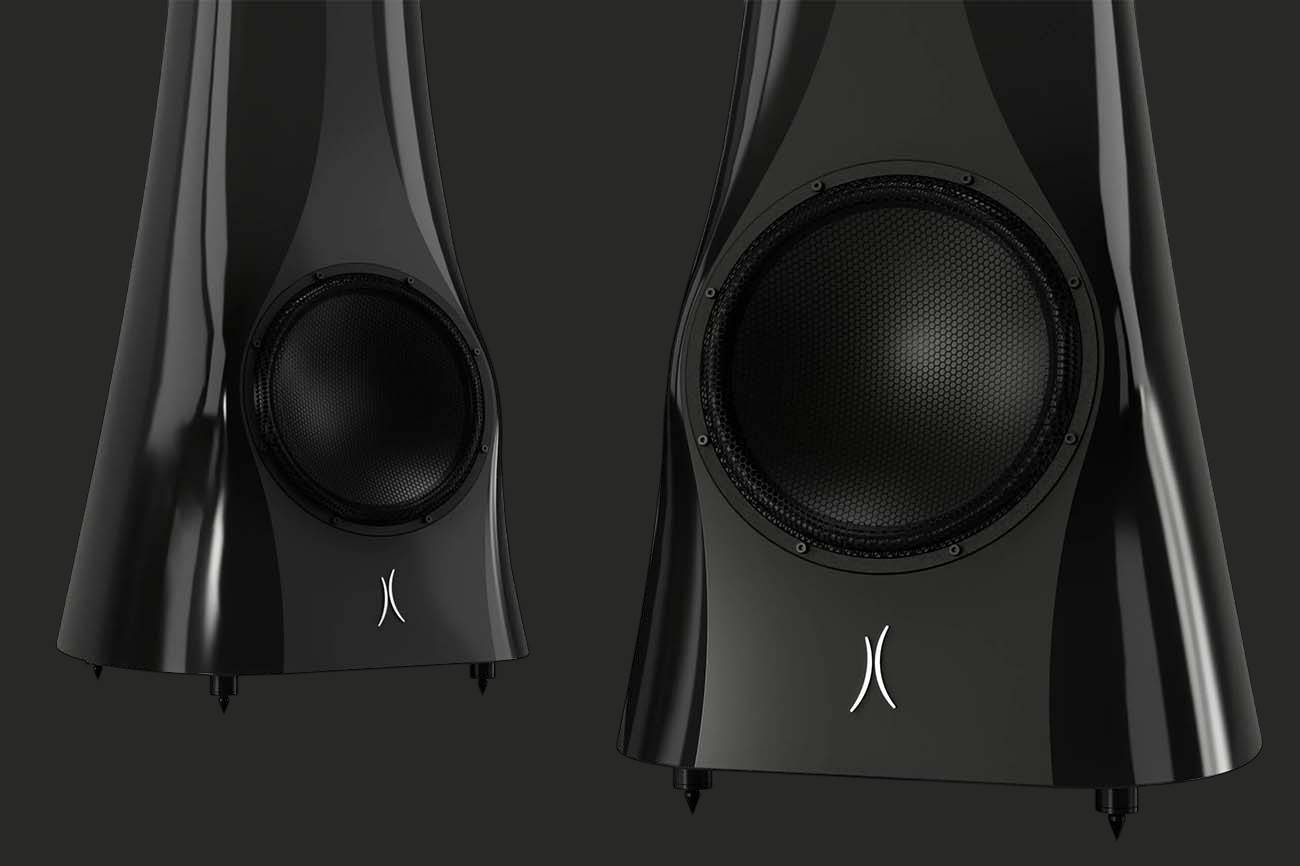
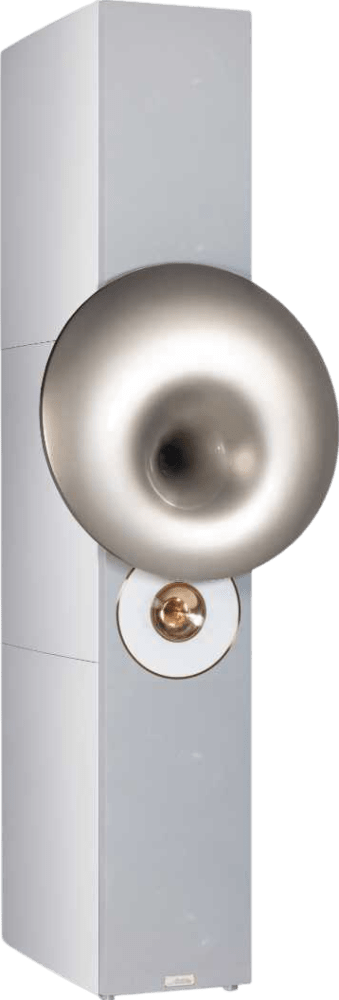
- Three-way system with a quad of 15-inch woofers, the signature hyperspherical horn for the mid/highs and above 5kHz, and the firm's famous ion tweeter
- Large cone surface coupled to a special dual bass reflex system promised abysmal reach down to 16 Hertz
- The cabinets exploit a sandwich construction of Ply, MDF and acrylic plus secret insulators and adhesives
Product Considerations
- At 300kg each, Hyperion is immovable once installed on a sufficiently strong floor
- Requires weeks of lead time until final delivery and on-site setup
Takeaway: The Hyperion seems to create a persuasive live illusion. The speakers scale the music with care to conjure up a most persuasive experience.
Video review
About the brand

What reviewers think
Video review
About the brand
What reviewers think
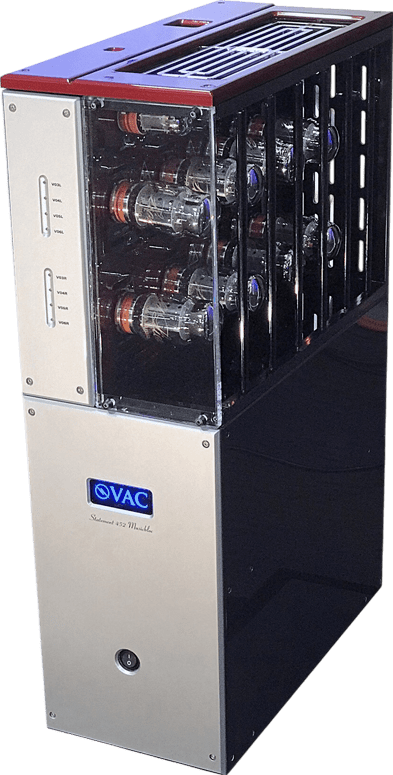
Product Strengths
- Exceptional musical resolution with an organic, natural, and coherent voice, achieving both transparency and musicality
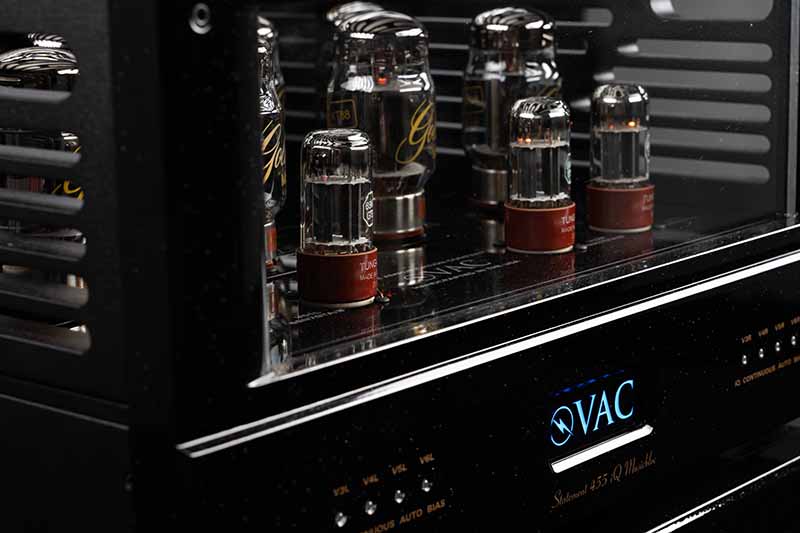
- A patented iQ Continuous Automatic Bias System continuously monitors and adjusts individual tubes
- Accurate timbre rendering with unassailable truthfulness, conveys tonal color in remarkably fine gradation of shading and articulation
- Authentic and credible spatial reconstruction of recordings, especially when paired with speakers known for their spatial accuracy
- A limitless sense of dynamic contrast—sounding powerful with a complete absence of strain
Product Considerations
- Large-scale microdynamic performance, small, low-level dynamic gestures smooth and level off dynamic contrasts
- The vertical tube layout could lead to uneven tube temperatures, with the top tubes running hotter
- Minimal specifications are included in the manual, lacking detailed information for potential buyers
- The amplifier is heavy, weighing 280 pounds in its flight case
- Retubing can be expensive
Comparisons (according to reviewers)
- It does not kick as hard as solid-state amps
- The VAC 452iQ exhibits a sheer dynamic scale that the ampsandsound Zion Monos cannot achieve
Takeaway: The VAC Statement 452 iQ Musicbloc is a top-tier tube amplifier known for its sonic purity, dynamic capabilities, and engaging musicality that brings recordings to life. It offers a unique blend of classic tube warmth with modern precision and control, and its iQ system is a great addition.
Video review
About the brand

What reviewers think
Product Strengths
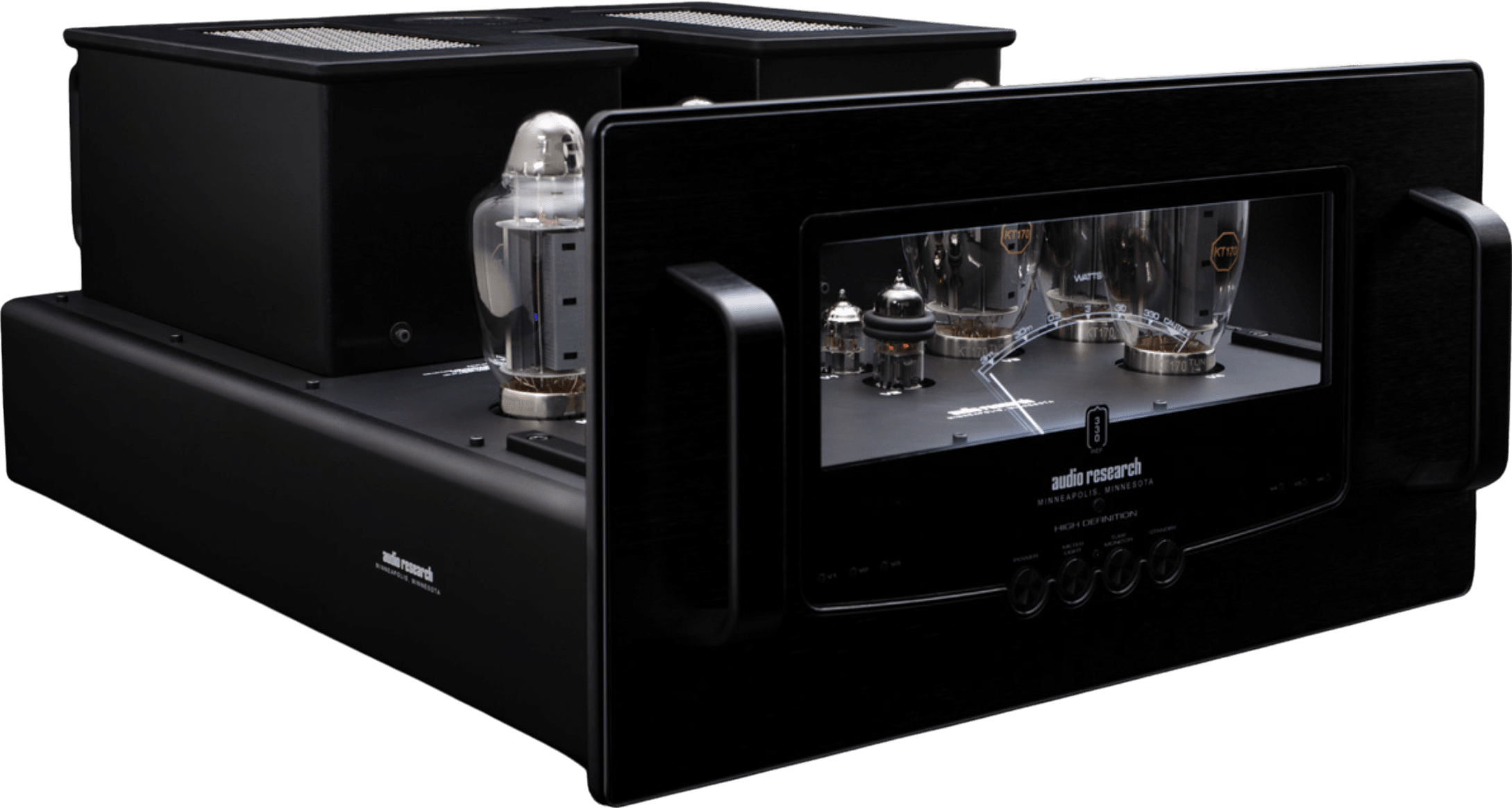
- Fully balanced design, handcrafted in the USA
- Employs a sextet of KT170 valves, ECC83, and 6H30, with hand-selected and matched valves
- Features Audio Research's 'Auto-Bias' circuitry and an internal hour meter for monitoring valve usage
- Aesthetically elegant design with unique 'Ghost Meters' which are LED-illuminated and can be dimmed or switched off
- Capable of delivering high power at low frequencies, controlling and driving speakers like a big solid-state amplifier
Product Considerations
- High price point
- Requires a 20A IEC cable (supplied)
- The bass control and sheer bass output of the Gryphon Audio Antileon EVO (solid state) could not quite be matched by the Reference 330M
- The unit use a variable speed fan, although it was essentially silent during testing, this may still present a point of concern for some users
Comparisons (according to reviewers)
- Vs Gryphon Audio Antileon EVO: The Gryphon Audio Antileon EVO (solid state) has slightly better bass control and output
Takeaway: The Audio Research Reference 330M is an intelligently engineered and beautifully styled amplifier that embodies the meaning of 'Reference' in sound quality. Its powerful valve design delivers excellent performance and is sure to be a conversation piece in any high-end audio setup.
Video review
About the brand

What reviewers think
Product Strengths
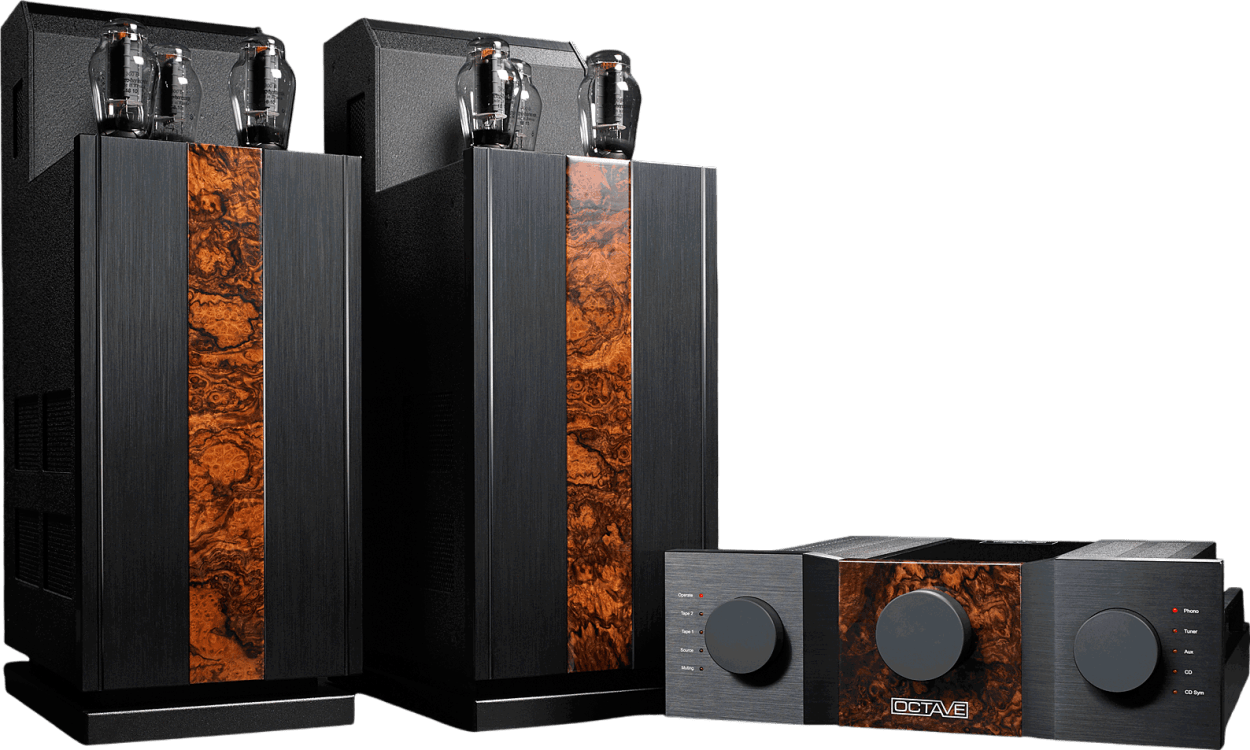
- The Jubilee 300B monoblocks largely solve the low output problem of SET amplifiers, offering from 15 to 30 W, depending on the selected amplification mode
- The amplifier offers excellent differentiation, delivering an extremely dynamic, energetic sound and differentiating subtle differences in color to an above-average degree
- The amplifier extends bass very low and allows large phantom images to be built, and creates a dense—extremely wide—sound stage
- The Jubilees convey a sense of reality that usually requires a high-current solid-state amplifier, striking a perfect balance of tonality and dynamics
- The Octave Jubilee monoblocks have the delicacy, the airiness and that extra dimensional palpability that tubes bring to the listening experience, yet have the weight and sheer dynamic thrust that only comes with high power
Product Considerations
- The manufacturer suggests specific output settings should be used for loudspeakers with certain efficiency ratings
- When tube banks deviate by more than 15%, it's replacement time
- The manual specifies a load no less than two ohms, so there may be a few speakers that the Jubilees will not drive
Comparisons (according to reviewers)
- The Jubilee 300B shares a similar presentation with the Kondo OnGaku
- Only the FM ACOUSTICS 711 MK II and soulution 710 could generate a sound of this class
- The Audio Research REF amps are a bit more in the 'just the facts, ma'am' category
- The current conrad-johnson ART series tends to embellish somewhat in a more saturated kind of tonality
Takeaway: The Octave Jubilee 300B is a remarkable amplifier with a fantastic musical experience. The Jubilee delivers the sound that fans of 300B tubes dream of, but with a larger scale and better control.
Video review
About the brand

What reviewers think
Video review
About the brand
.png)
What reviewers think
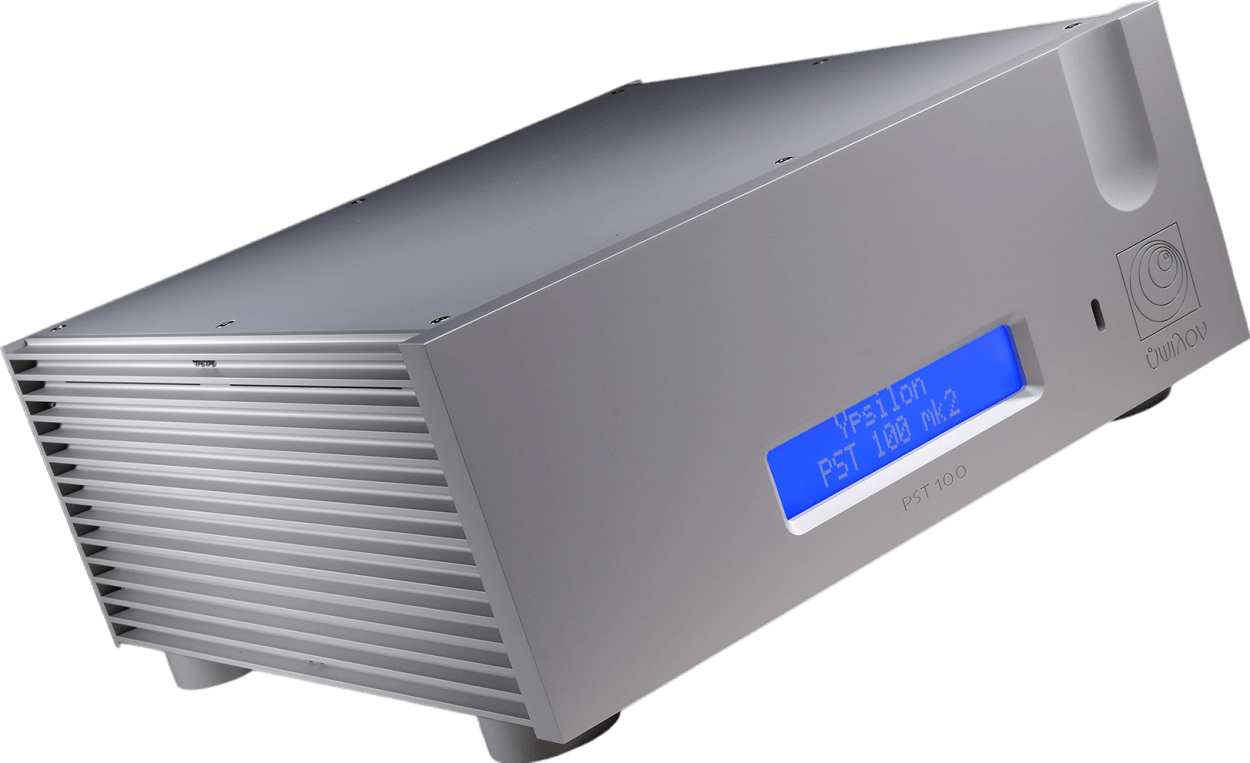
Product Strengths
- More holographic soundstage
- It marries tubes to a transformer controller and is dead quiet
- Design defies categorization, using two Siemens C3m triode tubes
- Offers the option of operating in purely passive mode
- Produces that Ypsilon 'nonsound' heard at audio shows, seeming to evaporate and leaving behind less residue and more music
Product Considerations
- Controllable only by the remote—there are no controls on the preamp itself
- Balanced operation requires Ypsilon's BC1 Transformers, which adds significant cost
- In passive mode, the manual suggests not running the system with sources whose output impedance exceeds 3k ohms
- On/Off switch is on the rear panel, which is less than optimally convenient
Comparisons (according to reviewers)
- Vs MBL preamplifier: The Ypsilon offers a more holographic sound stage, while the MBL preamplifier is a little bit more exact, a little bit more 2 dimensional and faster
- Vs Audionet GR2 preamplifier: The German preamplifier is a little bit sweeter in sound and has a little bit more depth and further back sound stage than the Ypsilon
- Vs Pass Labs XP-20: The Ypsilon PST 100 does performer separation more naturally
- Vs darTZeel NHB-18NS: The Ypsilon produced more vivid colors, as well as a level of transparency and purity
Takeaway: The Ypsilon PST-100 Mark II is a striking unit which brings music to life with its holographic sound and ability to operate in active or passive mode for maximizing signal purity. This reference preamplifier can be used for years without needing to upgrade.
Video review
About the brand

What reviewers think
Video review
About the brand

What reviewers think
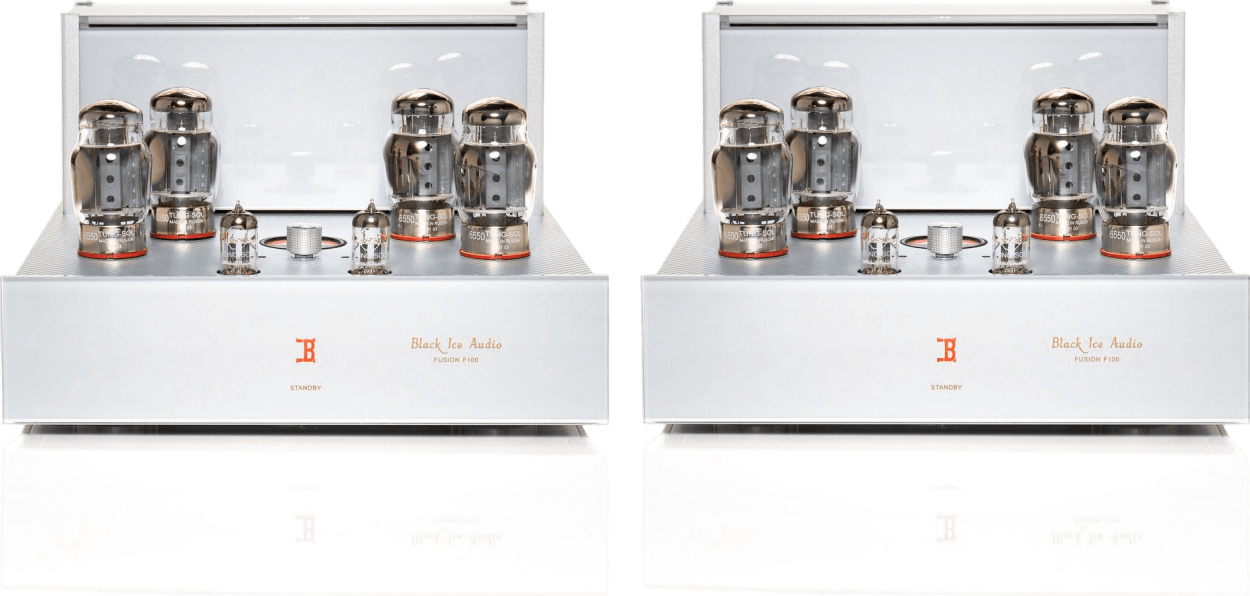
Product Strengths
- Fully balanced input to output tube design
- Can accommodate a wide range of power tubes, each with a different musical voice, offering versatility in sound
- The Odyssey circuit design has high gain, low distortion, and low output impedance
- The amplifier is hand-assembled in the USA
- Reproduces realistic sound dimensions, including height, unlike ear-bud gizmos
Product Considerations
- The 12AX7 tubes have a nine-pin base, and the corresponding ceramic tube sockets are high quality and hold the tube pins in a very tight grip, so care needs to be taken that all the pins of the tube line up precisely with the base sockets
- It may be necessary to periodically check and adjust the tube bias
Comparisons (according to reviewers)
- It was hearing things in mixes that were slightly buried with the Orchard amps
Takeaway: The Fusion F100 offers a versatile and powerful listening experience due to its ability to use different tubes and its quality internal design. This amplifier could be a great fit for audiophiles looking for a world-class tube amplifier with detailed sound and rich imaging.
Video review
About the brand


What reviewers think
Product Strengths
- The EVO 300 runs EL34 tubes at a conservative 440 volts, increasing tube life and reliability
- Adaptive auto bias ensures tubes work together in their perfect linear operating position, reducing distortion and extending tube life
- Point-to-point wiring gives the product an intrinsic value and increases longevity
- High-quality components like TACMAN resistors, Nichicon capacitors, and Swiss-made silver-plated oxygen-free copper wiring are used
- It includes an AC Offset Killer to reduce mechanical hum from the power transformer
Product Considerations
- EL34 tubes are not as durable as KT120s
- If KT-150 tubes are used, the tube cage cannot be installed, because the tubes are too tall
- Switching from ultralinear to triode operation cuts the power in half, requiring volume adjustment for fair comparison
- The reviewer recommends using the speaker tap that 'sounds best' rather than relying on the speaker's impedance rating
Takeaway: The EVO 300 Power Amp is a high-quality amplifier designed for everyday use and long-term reliability. Its flexible design lets you experiment with different tubes and sound signatures.
Video review
About the brand
.png)
What reviewers think
Product Strengths
- Renders rich vocals full of body and quite natural-sounding
- Delivers EL34 sweetness
- Intense punch and attack, traits more often associated with solid-state than tubes
Takeaway: The MB-185 is a tube amplifier that delivers rich, natural vocals and intense punch. It brings out EL34 sweetness in sound.
Video review
About the brand