


Welcome
Every speaker setup relies on an amplifier, which takes modest electrical signals and magnifies them enough to move the drivers effectively.
Although your phone or computer includes a built-in amp, a standalone unit can significantly elevate your listening experience. It delivers more headroom, tighter control, and a richer overall sound.
Why does it matter? High-quality amplifiers draw on robust power supplies, premium parts, and refined circuitry to maintain clear, consistent output—even when the music gets complex. They also provide superior damping (managing speaker motion) and can handle power-hungry speakers that smaller devices can’t drive properly.
Many models come with helpful extras like balanced inputs, multiple gain settings, or remote capabilities.
If you’ve already invested in decent speakers and want to hear their full potential, a proper amplifier is a must. It isn’t just about higher volume—it’s about enhancing dynamics, clarity, and authority.
What to look for when choosing an amp


So you want to buy a new amplifier, but you are not sure what you should pay attention to. At ExtremeHiFi, we have the world's largest database for audio products. Here is a brief overview of the most important functions and design aspects that distinguish amplifiers and that you should pay attention to.
The first and most important aspect of an amplifier is how much power it has. Can it actually drive your speakers? The easiest way to check this is to look at what the manufacturer recommends for your speakers. At ExtremeHiFi, you can see the recommended performance in the specifications section and ask your manufacturer if they don't provide this information.
Certain types of speakers, such as horns, are often much more sensitive and in many cases require only a little wattage to become extraordinarily loud. Therefore, you shouldn't buy a 100W per channel amplifier for sensitive horns, as you won't use most of the dynamic range of the amplifier. You'll achieve better results with a lower-powered amplifier. However, if you have something like Focal Grande Utopias that require a few hundred watts, you should make sure that you buy an amplifier with sufficient power to drive the speakers properly, without being too quiet or distorted from overexertion.
In the upper market segment, many people prefer monoblock amplifiers. These amplifiers only have one channel, so you have to buy two of them. This can have some advantages in terms of quality. They take up more space and probably cost more than a corresponding stereo amplifier. However, since the amplifiers are spatially distant from each other, there is no possibility of electrical interference or so-called crosstalk between the two channels. In addition, they have their own power supply. So if one channel is heavily tasked, the other is not affected in any way. They have their own heat dissipation, and with monoblock amplifiers, you can generally achieve a slightly higher performance limit than with a stereo amplifier.
When deciding which amplifier to buy, there is a third criterion that can have a drastic influence on the sound that you actually get and on some compromises that you have to make. This is the class of the amplifier, where the three most common options are Class A, Class AB, and Class D.
Class A amplifiers have the reputation among audio experts to offer the best sound quality. This is mainly because Class A amplifiers are the purest form of audio amplification. They have a single or a group of transistors that amplify the entire cycle of the audio signal—completely positive and negative. This means that the behavior at different levels is extremely consistent, and many people think that Class A amplifiers sound best.
But that's a trend, not a rule. There are many terrible Class A amplifiers, but also many fantastic Class AB and Class D amplifiers.
In fact, most people do not use Class A amplifiers because the compromises that you have to make are quite large. They generate a huge amount of heat. If you need a stereo amplifier with 100W per channel, a Class A amplifier could permanently draw 800W from the socket, even at idle, and release this power as heat into your room. Especially if you have high power demands for your speakers, a Class A amplifier may simply not be practical.
Class AB amplifiers work similarly to Class A amplifiers. Instead of a single group of transistors that amplify the entire positive and negative cycle, they have one group that amplifies the positive cycle, another group that amplifies the negative cycle, and the summed output signal is the intended audio signal. This has the advantage that they are much more efficient. At idle, they don't consume as much energy as a Class A amplifier. They run much cooler, and you can often get much more power from a physically smaller device because you don't have to dissipate so much heat.
However, this also means that the distortion behavior of Class AB amplifiers in relation to the output level can be slightly different from that of Class A amplifiers. Nowadays, however, the quality difference between Class A and Class AB amplifiers has diminished significantly compared to earlier times, possibly even no longer existing. There are some fantastic Class AB amplifiers on the market.
So if you have very sensitive speakers, it can still be worthwhile to look at Class A amplifiers, as it is much easier to get a Class A amplifier with 20W per channel than one with 100 or 200W.
However, if you have power-hungry speakers, don't think that you have to sacrifice a lot when buying a Class AB amplifier, as some of the Class AB products on the market are really extraordinary.
Now, there is a third category of amplifiers that is becoming more and more popular, the so-called Class D. These amplifiers work completely differently than Class A and Class AB. Instead of amplifying the signal one-to-one, they actually turn it into a series of extremely high-frequency pulses. If you then use a low-pass filter that filters out the high-frequency components, the originally intended signal is reproduced.
Class D is particularly suitable for requirements with very high power and a small form factor. It is often found in subwoofers, in car radios, or in places where you need a lot of power in a small housing. This is because Class D is the most efficient amplifier type, often over 90 percent efficient. This means that they consume almost no more electricity than they actually output. They emit almost no heat.
Another important aspect to consider in addition to the amplifier class is whether you want a transistor or a tube amplifier. Tube amplifiers are usually Class A amplifiers but use tubes instead of transistors and are objectively less accurate than most transistor amplifiers. They have higher distortion and color the sound more than a typical transistor amplifier. But the reason why so many of them are still produced and why they are still so popular is that some of these distortions and colorations provide a really pleasant end result that many people prefer over a more neutral, linear, or accurate sound. So if you prefer a warmer, slightly colored, but more pleasant sound, a tube amplifier could be something for you.
Regardless of how powerful your required amplifier should be or which amplifier class you prefer, you should consider whether you need a power amplifier or an integrated amplifier. Power amplifiers are extremely common in audio technology and do not have their own volume control. They are called power amplifiers because they provide a fixed gain. They take an input signal that is amplified by a fixed amount, and that's all. For this reason, when buying power amplifiers, you should make sure that either your DAC has an integrated volume control that you can use, or that you use a separate preamplifier for the volume control.
Power amplifiers don't omit volume controls for cost reasons, but because for quality reasons you don't want to have the sensitive line-level circuit as close to a large, powerful amplifier as possible. For higher-quality setups, instead of an amplifier with an integrated volume control (which is referred to as an integrated amplifier), you usually use a separate power amplifier and then a preamplifier or a DAC with an integrated volume control, rather than having all the sensitive circuitry in the same device as the amplifier itself.
However, if you have limited space, you can look for an integrated amplifier, which combines the functions of the power amplifier and the preamplifier and often includes both the input circuit and the volume control. Sometimes the DAC itself is also housed in the same device.
There are so many different amplifiers on the market, which are all suitable for different tastes and preferences. The best way to find out what is actually suitable for your personal preferences is to read the reviews and see what people say about them. With ExtremeHiFi, this is very easy thanks to our rating system. You can go to each product page and take a quick look. This gives you an overview of what people think about it and which competing products you should pay attention to.
Products on this list




.svg)
What reviewers think
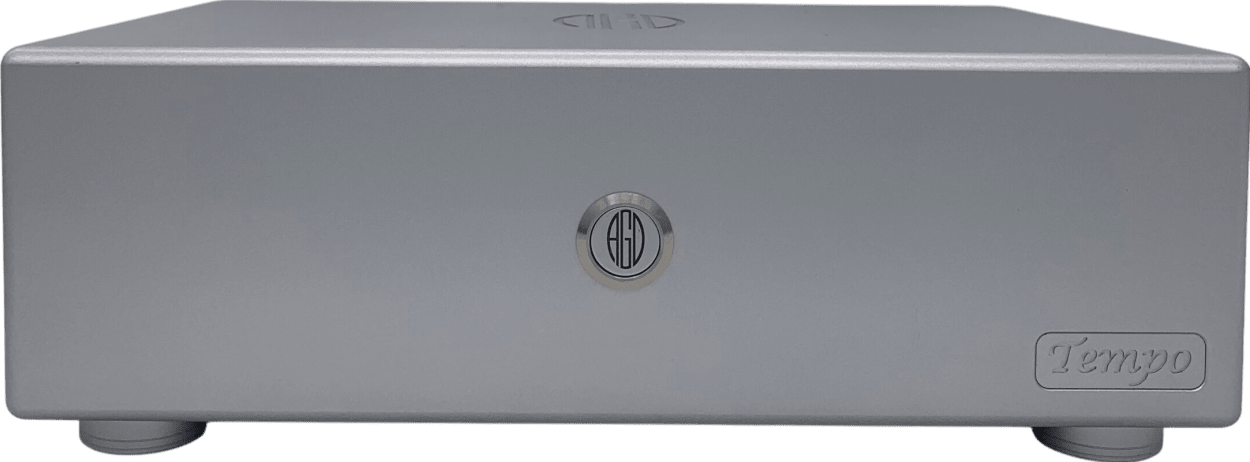
Product Strengths
- GaN technology allows for efficient power usage, with 94% of energy being turned into sound
- Compact size challenges the notion that high-quality amps need to be large
- Design and packaging create pride of ownership
- It can be run in bridged mode to deliver 400 watts into one channel
- Stability and ability to handle complex impedance loads
Product Considerations
- The slight sonic signature may not be for everyone
- If truly outrageous amounts of power are needed to drive speakers, a second AGD Tempo amp might be needed to run in a bridged configuration
- High-frequency noise was discovered when XLR cables were not connected between them
- Power cords can make a large difference, the included power cord doesn't flatter the amp
- Some traditionalists may find it hard to accept that it's a Class-D amplifier
Comparisons (according to reviewers)
- Compared to Peachtree Audio GaN400, the AGD Tempo reports to have better overall specifications
- Compared to Parasound Halo A21+, the AGD Tempo is simply superior
- Compared to Bricasti M30 monoblock amplifiers, the level of which the most subtle detail exists approaches reference Bricasti M30 monoblock amplifiers
Takeaway: The AGD Productions Tempo is a cutting-edge amplifier that offers a new take on audiophile amplification and rivals more expensive amplifiers. It can drive speakers easily while being energy efficient.
Video review
About the brand

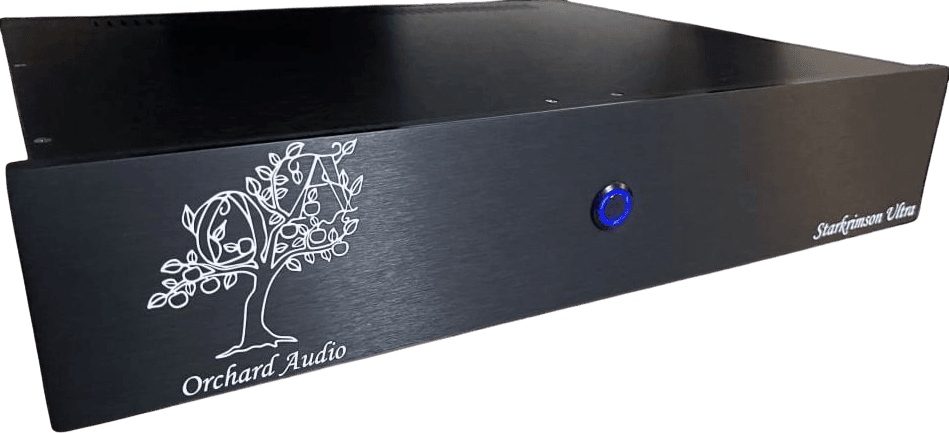

What reviewers think
Product Strengths
- Exceptionally transparent sound output quality
- Exceptionally powerful, capable of outputting 500W into a 4-Ohm load
- Delivers a remarkably clean, transparent sound with very little noise or distortion
- The amplifier's ability to reproduce bass is awe-inspiring and delivers deep, powerful bass without distortion
- Runs cool and weighs very little for its sound output, making it easy to move around
Product Considerations
- Options can be a little pricy, such as the 12v trigger and RCA inputs
- The Starkrimson Stereo Ultra may lead to further system upgrades
- Depending on your sources, the Starkrimson Stereo Ultra will play exactly what you feed it, good or bad, and if your source components are slow, the Starkrimson Stereo Ultra will not speed them up
- Power on only after all connections are properly made, including the power cord, analog inputs, and speaker outputs, and wait five minutes after powering it off before removing any of the connections
Comparisons (according to reviewers)
- Compared to the Krell S550i integrated amp, the Starkrimson Stereo Ultra showed a much faster and finer resolution of the upper frequencies of the human voice and a far greater ability to play more of the microdetails of a recording
Takeaway: The Starkrimson amplifier is well-built and provides a level of speed and transparency to hifi music that makes listening to music very fun. Its GaN modules can be upgraded and it is available in several configurations.
Video review
About the brand

What reviewers think
Product Strengths
- Runs cool and weighs very little for its sound output
- Delivers exceptionally transparent sound output quality and is exceptionally powerful
- Uses GaN modules that can be upgraded
- Shows a much faster and finer resolution of the upper frequencies of the human voice, and a far greater ability to play more of the microdetails of a recording
Product Considerations
- Depending on your sources, the Starkrimson Stereo Ultra will play exactly what you feed it—good or bad
- If your source components are slow, the Starkrimson Stereo Ultra will not speed them up
- The Starkrimson Stereo Ultra may lead to further system upgrades
- It must not be powered on until all connections are properly made
- One must wait five minutes after powering it off before removing any of the connections
Takeaway: The Starkrimson is a very transparent and powerful amplifier that can reveal new levels of detail in music. It is a great choice for audiophiles looking for exceptional sound quality and the ability to upgrade its components
Video review
About the brand


What reviewers think
Product Strengths
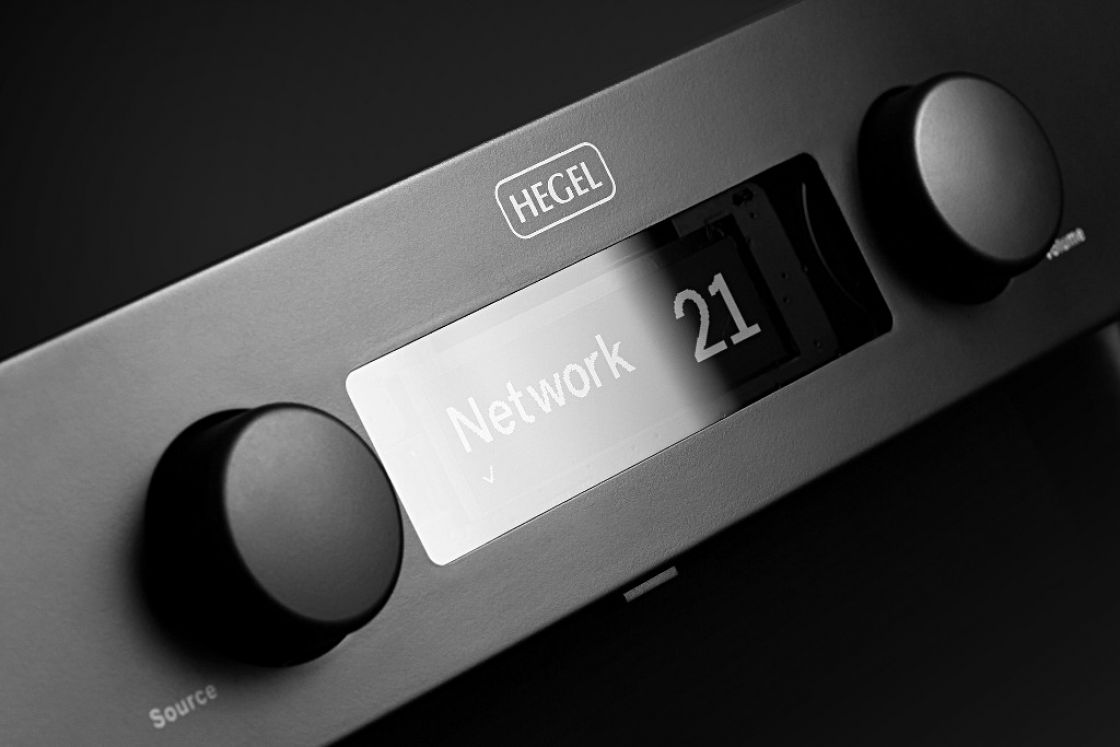
- Improved DAC from the H90, using the same DAC as the H120 and H190 models, which offers a massive step up in D/A conversion
- Well-balanced, neutral, and realistic sound, with better dynamics, transparency, and soundstage than its predecessor, the H90
- Streaming capabilities, such as Spotify Connect, AirPlay, and UPnP, make it a versatile all-in-one system
- SoundEngine 2 technology reduces distortion effectively
- Simple, clean, and understated aesthetic
- Requires LAN cable for network connection, as it has no wireless connectivity
Product Considerations
- Front panel is made of plastic
- USB input is limited to PCM resolutions of 24bit/96kHz
- Lacks Roon endpoint capability and does not support playback of DSD files
- Remote control is plastic; the metal RC8 remote is an additional cost needed to set start up and maximum volume levels
Comparisons (according to reviewers)
- Vs H90—H95 has a better power supply, a new board with streaming circuitry and digital-to-analog conversion, and an improved headphone output
- Vs H90—H95 also provides better dynamics, transparency, and soundstage
- Vs H120 & H190—H95 shares the DAC from these models but lacks some of their higher-end features and custom installation facilities
- Vs Primare I15 Prisma—the Primare I15 Prisma is a serious rival, offering a bolder sound and Prisma network platform
- Vs Schiit Ragnarok 2 Fully Loaded—H95's sound was slightly smoother
- Vs Cyrus ONE Cast—the H95 is sailing on much closer waters to the Cyrus ONE Cast, thanks to its thick blend of connectivity, features and ergonomics
Takeaway: The H95 is an integrated amplifier for those seeking modern streaming features and quality sound without overspending. It is an all-around good choice for building a simple home audio system.
Video review
About the brand