

Welcome
The best hifi deals aren't just about lower prices – they're about finding equipment that performs far better than its cost suggests. This is where real value exists.
Take a $500 amplifier: while it might seem expensive to newcomers, finding one that matches the sound quality of $3,000 models represents exactly the kind of market opportunity worth jumping on.


Products on this list





.svg)
What reviewers think
Product Strengths
- High-res audio supporting up to 192.24 and supports most of the top streaming services, and continues to add more through updates
- Great software that is reliable and simple to use, with frequent updates
- Offers multiple digital output options to output to the hardware of choice
- A bit-perfect streamer that offers gapless playback
- Provides a lot of options in regards to connectivity and integration within an existing system, and throughout the home using its multi-room capabilities
Product Considerations
- The internal DAC is completely usable, but a bit lackluster for some systems
- No native support for Apple Music within the WiiM app
- The exterior feels a bit plastic-y
- There is no means of getting 32-bit, 384K PCs to an external DAC via USB, nor a means to connect a USB storage device or CD drive to the WiiM streamer
- For the volume control to work on these line inputs, it has to get converted from the analog signal coming in, through an analog-to-digital converter, and then it's adjusted in terms of volume in the digital domain to keep it all lossless
Comparisons (according to reviewers)
- Vs Sonos Port: Functionality is superior to the Port
- Vs EverSolo DMP-A6 (as streamer): No significant difference, no discernible difference between the A6 and the WiiM streamer
Takeaway: The WiiM Pro is an affordable and feature-packed streamer that can satisfy anyone's needs or wants from a music streamer. It is a great way to get into streaming with the flexibility to upgrade later with an external DAC.
Video review
About the brand


What reviewers think
Product Strengths
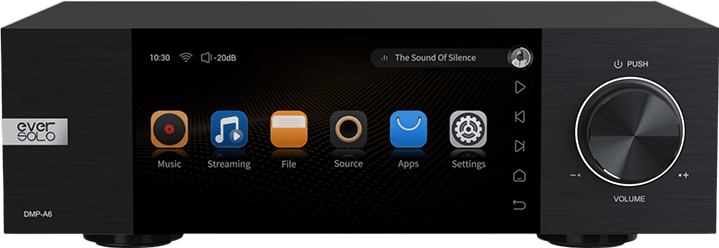
- Excellent and responsive touchscreen display, and user-friendly interface that is intuitive and easy to navigate
- Versatile as an all-in-one device, functioning as a streamer, DAC, pre-amp, and media storage server with a competitive price point
- High build quality, featuring a solid aluminum alloy chassis
- Supports a wide variety of streaming services, including Tidal, Qobuz, Spotify, Amazon Music, Apple Music, and more
- Rock solid as a streamer, especially when going into a separate DAC
Product Considerations
- Customer support from Eversolo may be limited, with some reviewers noting slow or nonexistent responses to inquiries
- Internal DAC, while good, is not on par with higher-end—more expensive DACs
- Lack of a traditional I/R remote could be a drawback for some users
- Some unusual control procedures are noted, such as the inability to power on the unit from the mobile app
Comparisons (according to reviewers)
- The DMP-A6 sounds just as good as the Lumin U2 Mini as a streamer
- The A6 beats the Bluesound Node when used only as a streamer
- The A6 has similar features, a similar control/display, and a similar size and shape
- The Lumin U2 has more "shine", dynamics, solidity and is a touch more refined than the A6
- The Eversolo is favored over the iFi Neo Stream, especially as a streaming DAC
- Eversolo proves it can play with Cambridge Audio CXN (V2) in many ways
Takeaway: The Eversolo DMP-A6 is a versatile and user-friendly streamer that delivers great value, and it provides a great streaming experience with its screen. It is a great entry point into high-resolution digital audio and can serve as the center of a modern hifi system.
Video review
About the brand

What reviewers think
Product Strengths
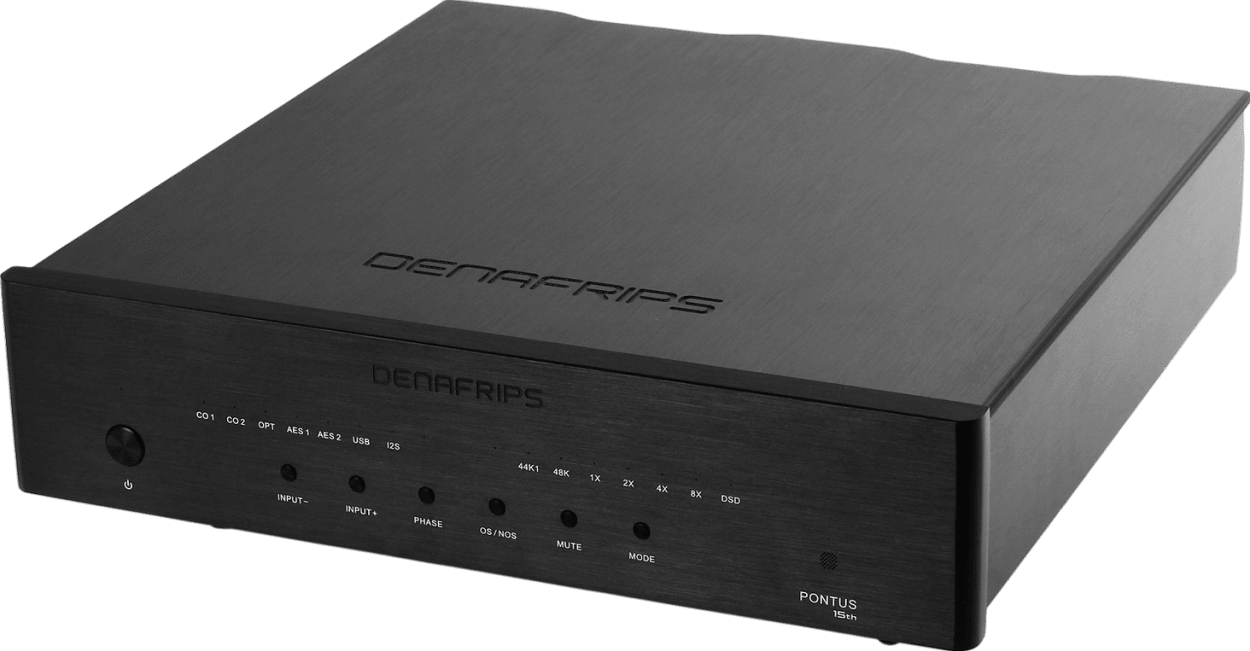
- Flawless build quality and built like a tank with an all-metal body and tactile buttons
- Delivers a linear presentation and keeps the soul of the music intact, sounds inviting, smooth, and transparent
- Provides an open, deep, and wide soundstage
- Excels in micro detail and nuanced sound and airiness with excellent clear vocals
- Is an upgrade from the original Pontus and provides better layering
- Offers great connectivity with all the digital inputs needed, including I2S
Product Considerations
- Denafrips makes incremental changes, which can be annoying if a newer version is released soon after purchase
- Does not include a remote, and one must be purchased separately
- May be a little bright for a lean or bright sound system, it is best in a neutral to warm system
- There is no middleman/distributor anymore, which may mean loss of personal touch from customer to the company—especially with warranty issues
Takeaway: The Pontus 15th Anniversary Edition is a well-built DAC that delivers a refined and detailed sound with a wide soundstage, making it a great choice if you have a warm or neutral system that needs some sparkle. It has excellent connectivity options.
Video review
About the brand


What reviewers think
Product Strengths
- Exceptional build quality with a combination of black brushed aluminum and copper-plated sides
- Produces a big and deep soundstage with great layering and instrument pinpointing
- Dynamics are very good, lively sounding, punchy when needed, and refined when refinement is needed
- Detailed and natural, with great spatial abilities, it sounds clean, well-timed, and almost free of sibilance issues
- A true NOS DAC, meaning perfect time domain, without pre or post echo's
Product Considerations
- Automatic input switching can be a 'nightmare', 'stupid design choice' and 'really annoying', it hangs on to the last input until the device is fully powered down
- Lacks manual input switching, a remote control, a screen, or oversampling filter selection, making it 'quirky' in terms of functionality
- Highs may have a bit of roll-off
- The bright LEDs on the front panel might be an issue for some
- Reading the print beside the LED indicators of input and sampling rate from a distance may be challenging
Comparisons (according to reviewers)
- The Cyan II throws out a much wider and deeper soundstage with more tangible localization of performers and has fleshed out bass and mid-range, compared to the Topping D90
- Cyan II is considerably cleaner in the bass and lower midrange with more precise stereo imaging, compared to the Denafrips Ares 12-1, but the Denafrips is weightier in the lower frequencies, has a richer tone, provides more texture to notes and a more revealing top end
- The Cyan II is a little weightier in the bass and fuller in the mid-range, whereas the Gustard R26 is a bit more detailed and precise, especially on top
- Cyan edges it out in soundstage and dynamics, and feels more natural, compared to the Chord Mojo 2
- The Denafrips Aeris 15 sounds softer and warmer, the Holo Audio Cyan 2 has a punchier but firmer bassline, and the Aeris 15 has more high frequency extension
- Cyan 2 will present it more behind your speakers, and some things will appear to be more focused and denser and deeper behind the speakers, whereas Harmony Live Deck will push them a bit forward, as the Harmony Live Deck is a tonally more forward sounding deck
Takeaway: The Cyan is a well-built DAC that produces great sound quality. With excellent soundstaging, good dynamics, and a natural sound, the lack of features is easily forgiven.
Video review
About the brand

What reviewers think
Product Strengths
- Creates a very open and transparent soundstage, which crosses the threshold of believability in a small to medium-sized room
- Low distortion, especially in the midrange and upper bass, making listeners realize how imperfectly transparent many speakers are
- Highly resolving, with impressive performance on acoustical instruments and vocal reproduction
- Offers a unique and remarkable experience due to the story and love behind the speaker's creation
- Presents a challenge, helping users understand speaker positions as the sound changes completely with movement
- Considered 'eminently affordable' and provides incredible sound for the price
Product Considerations
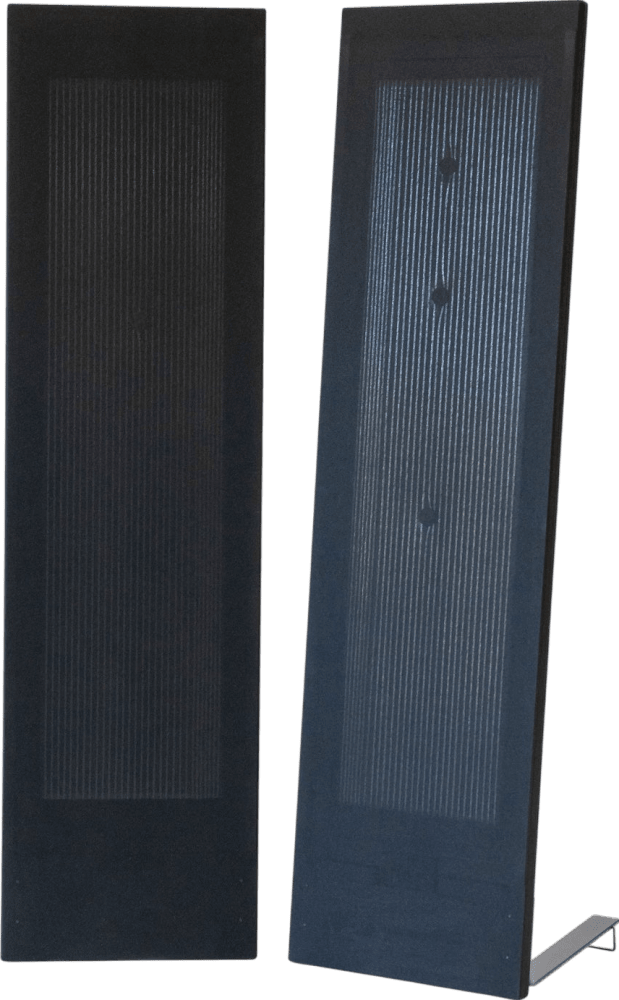
- Requires significant time to install, tweak, and dial in due to its dipole design, making positioning critical
- Bass is not powerful—it doesn't do pounding bass, and listeners won't feel the bass pounding on their chest, so a subwoofer might be needed, especially for rock, pop, dance, and electronic music
- Needs good power and high current to sound clean and not cause fatigue, it is not a powerful-sounding speaker
- The stand included is considered subpar and not very versatile
Comparisons (according to reviewers)
- Vs the original LRS, the LRS+ has ameliorated treble, has smoother upper mids, and has a reduced nosedive in the power range and midbass
Takeaway: The Magnepan LRS+ is a special speaker with an open soundstage, great details, and makes music sound real and enjoyable. Though not perfect, it is well worth buying because it offers an excellent way to experience a panel speaker without spending too much.
Video review
About the brand

What reviewers think
Product Strengths
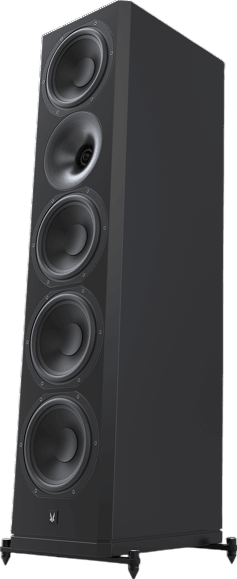
- Exemplary build quality using HDF (High-Density Fiberboard) and high-quality cabinet material, resulting in an extremely inert and resonance-free cabinet
- High sensitivity (92dB) makes them easy to drive with a variety of gear, including low-wattage tube amplifiers
- Good bass extension, eliminating the need for a subwoofer in many setups
- Excellent imaging
- Sleek appearance
Product Considerations
- Optimal sound may require experimentation with placement, especially angling and distance from the back wall
- The tweeter can sound a little hot or forward on-axis, requiring careful angling or the use of tubes
- Soundstage depth and three-dimensionality may be less pronounced compared to smaller stand-mounted speakers
- Separating the tweeter power from all of the bass drivers may have been a mistake, as it could have been separate for the top two woofers and tweeter from the lower two woofers
- The weight of the speaker—at 111 pounds each—can make them difficult to move and position
Comparisons (according to reviewers)
- Arendals favored for dynamics and build quality—compared to SVS Ultra Evolution Pinnacle
- Arendals favored for build quality and dynamic range—compared to MartinLogan Motion XT F100
- JBL has a smoother on-axis response, but the Arendal does not have the disadvantage of a high-mounted tweeter for small rooms and close listening distances—compared to JBL HDI-3800
- Arendals have better mid-range and high-frequency quality with more nuance qualities in the bass—compared to Polk R700
- Arendals preferred due to the deep bass—compared to CSS Audio Typhons
- Arendal is more resolving, has a tighter bassline, a bigger soundstage, and is easier to drive—compared to Dynaudio Focus 360 or KEF R7
Takeaway: The Arendal 1723 THX towers offer great sound, good bass, and excellent build quality for the price. They are versatile speakers that can work well for both music and home theater.
Video review
About the brand
What reviewers think
Product Strengths
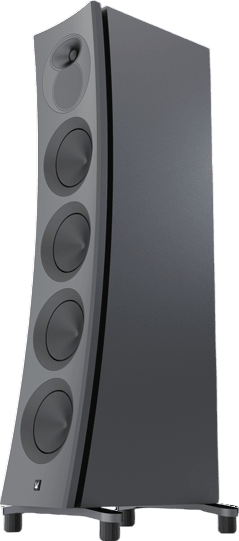
- Excellent build quality, using high-density fiberboard (HDF) and advanced bracing for a solid and sturdy feel
- Impressive bass output and extension, often compared to having a pair of smaller subwoofers, making it suitable for full-range listening
- Neutral sound signature, providing clear and detailed audio reproduction across the frequency spectrum
- Wide dispersion and seamless integration across seating positions, creating an immersive soundstage
- Dynamic capabilities, handling both subtle nuances and high-volume passages without harshness or distortion
Product Considerations
- Large size and heavy weight can be a challenge for smaller rooms, requiring planning and effort for installation
- High-quality amplification is demanded to reach its full potential, with AVRs not being ideal
- Optimal listening distance is recommended to be at least 3m, which may not be suitable for smaller rooms
- While the 1528 can be used as full range speakers, a subwoofer can still be beneficial
Comparisons (according to reviewers)
- Vs Arendal 1723, the 1528 is noticeably more detailed
- Vs Spendor Classic 3/1, the 1528 is more neutral, while the Spendor is warmer with darker treble
- Vs Cabasse Murano, the 1528 is more neutral, while the Cabasse Murano is slightly warmer in the midrange
- Vs Perlisten/KEF/Focal/Sonus Faber/Paradigm/RBH/Revel, the Arendal 1528 series holds its own against these storied names
- Vs Arendal 1723 THX Tower speaker, the 1528 can be seen as a worthy upgrade to the owners of the Arendal 1723 THX Tower speakers
Takeaway: The Arendal 1528 is a well-built speaker that sounds great, is capable of high SPL output, and delivers deep bass without distortion. Its neutral sound signature makes it suitable for both music and home theater, making it a versatile choice for those who have the space and the budget.
Video review
About the brand


What reviewers think
Product Strengths
- Runs cool and weighs very little for its sound output
- Delivers exceptionally transparent sound output quality and is exceptionally powerful
- Uses GaN modules that can be upgraded
- Shows a much faster and finer resolution of the upper frequencies of the human voice, and a far greater ability to play more of the microdetails of a recording
Product Considerations
- Depending on your sources, the Starkrimson Stereo Ultra will play exactly what you feed it—good or bad
- If your source components are slow, the Starkrimson Stereo Ultra will not speed them up
- The Starkrimson Stereo Ultra may lead to further system upgrades
- It must not be powered on until all connections are properly made
- One must wait five minutes after powering it off before removing any of the connections
Takeaway: The Starkrimson is a very transparent and powerful amplifier that can reveal new levels of detail in music. It is a great choice for audiophiles looking for exceptional sound quality and the ability to upgrade its components
Video review
About the brand

What reviewers think
Video review
About the brand

What reviewers think
Product Strengths
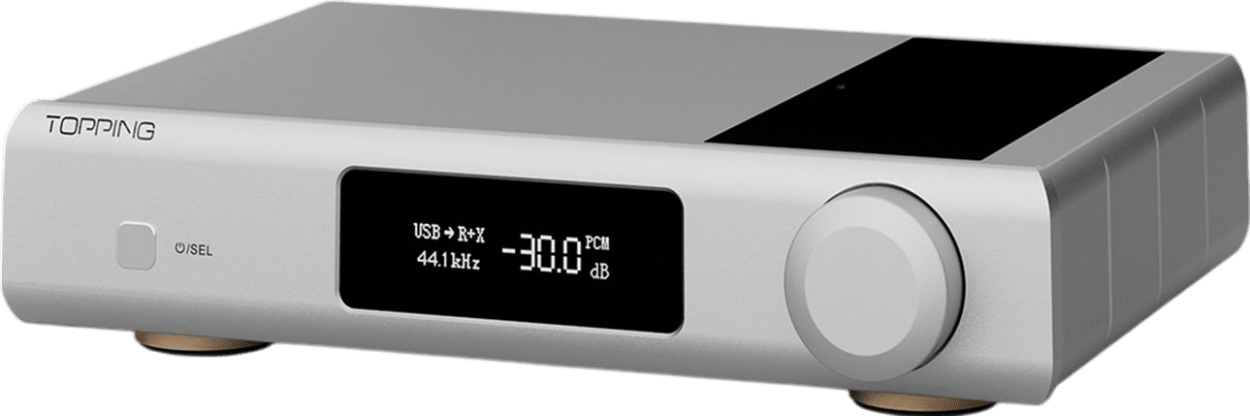
- Very detailed and resolving sound, capable of revealing nuances in music
- Fast, punchy, and dynamic sound, especially good for electronica, rock, and metal
- Produces a holographic soundstage with good depth and focus, better than some entry-level R2R DACs
- Has a very low noise floor, making it easy to focus on faint sounds
- Tonally neutral and linear frequency response, revealing the quality of the recording
Product Considerations
- The plastic remote control may feel cheap compared to the unit
- Some reviewers would prefer more warmth and life in the midrange
- Can sound analytical at times, lacking some refinement or lushness compared to some other DACs
Comparisons (according to reviewers)
- D90 Discrete is more detailed and resolving than the D90 SE/MQA
- D90 Discrete has higher resolution, dynamics, and snappiness, than the SMSL SU-10
- D90 Discrete has greater resolution, inner tone textures, and is snappier and punchier, than the Chord Cutest
- D90 Discrete is faster, more precise, and punchier, than the Holo Audio Scion 2
- D90 III Sabre has better transparency and dynamics, and is more forward-sounding, than the Topping D70 Pro Octo
- D90 III Sabre is more neutral, with a tidier and quicker bassline, and more etched tone edges, than the SMSL SU-10
Takeaway: The D90 offers impressive resolution, dynamics, and a holographic soundstage, making it a great option for those seeking a detailed and accurate listening experience. It has an honest, ultra-linear sound, especially good for audiophiles who don't want colorations.
Video review
About the brand